Showing posts with label academics. Show all posts

Friday, October 16, 2009

mapping things out

It's been a week of creative breakthroughs on my writing projects. My plans for the first two short plays I'm working on have started to become much clearer (in my head at least).

One especially useful exercise from class was creating an actual map of the audience's experience of your piece. Here's a detail of the journey I hope to take people on:

Think I can achieve this?? I've got about four weeks now to figure out how!

Will keep you posted on the development of both works. Tonight, the plan is to soak up more Elephant & Castle Latin American experience by going to a Colombian restaurant/discoteca that promises to feel like a little bit of Bogota in South London. Maybe I'll have pictures to post...

Sunday, October 4, 2009

community outreach

You might remember a previous post describing the four short plays that I need to complete for my course before the end of the Autumn Term. Well, I've begun work on two of them, and the experience of planning them has dove-tailed nicely with my desire to get to know London better.

On Friday, I spent more than an hour walking around Elephant & Castle:

Yes, that's a statue of the eponymous pachyderm. The area got its name, it seems, from a historic pub located on the site. The name "Elephant and Castle" seems to be an English bastardization of the name of a Spanish princess: La Infante de Castile.

Anyway, history aside, Elephant & Castle is now known (or avoided) by most Londoners as an overdeveloped area planned in the 1960's, which is comprised of two traffic roundabouts, a series of grotty pedestrian tunnels that can get you from one side of the street to the other, several housing projects, and a very tacky shopping mall.

To many, Elephant & Castle is a perfect example of bad 60's city planning that didn't take pedestrian life into consideration. There are calls for it to be torn down and many new design proposals for what can be put up in its place. It has struck me as an interesting spot to put on a site-specific outdoor performance (the platform in the picture above even looks a bit like a stage, no?)

Walking around the other day and mapping the area, I came across a number of interesting features: there's an old movie theater, a bingo parlor/bowling alley, a colorful area (below street level) of market stalls populated by a lively ethnic mix of vendors, and even a restaurant called La Bodeguita that seems to be frequented by most of London's Colombian community (which, to be honest, I hadn't even known existed). The network of pedestrian tunnels make for interesting staging opportunities and the mix of ethnic food stands can provide flavors and smells.

You can see from this shot that there's a conglomeration of bus stops (right near where that white tent is). My initial idea is to stage a night-time performance there for the assembled crowds of tired, drunk partiers who are waiting for London's night buses (the Tube shuts down around 12:30 AM). Perhaps involving distribution of empanadas from the Latin food stand next door? The fun thing about the project is that we have no budgetary or feasibility constraints since this is merely a proposal -- we don't actually have to stage it. I think my next step will be to hang around E & C a few more times and eavesdrop on people passing through in order to get some ideas for characters and stories...

Meanwhile, for my other assignment, I need to do research into a subject or a community that I have not had personal experience with. I immediately thought of the African community on Rye Lane in Peckham (near where we've been staying while we wait for the lease to start on our flat). You may remember my previous post about the African market along this road, which we pass through every time we go to the train. There are also a number of churches on the second stories of the buildings, from which one can hear incredible music emanating at different times.

I'm very interested in finding out more about the culture of these churches, most of which seem to be attended by African immigrants from Nigeria and Ghana. Below are some representative pictures (not my own) off of a website called Peckham Vision:

The research for the project can take on many forms. I've already been to the library to look into statistics about immigration from Nigeria to the UK, as well as the mixing of Christianity and traditional Yoruba religion. But the centerpiece of the work is supposed to be conducting interviews, so I'm hoping that I can meet some pastors and congregants of some of these churches and talk to them.

In a couple of hours, in fact, I'm planning to go down the street and see if I can sit in on a service...

All of this planning and research seems like a lot of work to do just for a 15-20 minute performance, but I'm truly curious to learn more. Being an outsider to London, I think I bring fewer pre-conceived notions to my investigations and everything that I discover has the appeal of being brand-new. I'll keep you posted on how these pieces are developing!

Thursday, September 24, 2009

beginnings

Yesterday, we had our first meeting of Drama postgraduate students at Goldsmiths. It was an exhilarating and somewhat overwhelming introduction to what I'll be doing over the course of the next year. It's going to be a whirlwind, but an exciting -- and hopefully growthful -- one!

Between now and December 10, we will be writing four short performance pieces:
  • a site-specific event, intended for performance outside of a traditional theater
  • a text created from research and interviews on some topic of interest
  • a play created for a "special audience" (in our case, teenagers -- a group I know well!)
  • a collaborative text created along with students studying directing and musical composition (which we must perform in, as well as write)
We'll be working on the first two simultaneously and the second two simultaneously. Each of the projects are an interesting challenge. I'm so pleased that we're beginning our studies with this diverse, all-over-the-map approach rather than just sitting down and discussing plot and character.

While writing those four pieces, we'll also be doing an intensive look at the new work that's going on right at the moment in the UK (the first text is Caryl Churchill's play about Gaza, Seven Jewish Children), which will feature sessions led by the artistic and literary directors of some of the leading theatres that produce new writing. We'll be assigned to go see a lot of productions, as well, such as David Hare's new play about the credit meltdown that's going on at the National Theatre.

We'll also be reading some exemplary and canonical works in order to understand different approaches to dramaturgy. I am pleased to say, though, that the selected texts are very much in line with my own set of aesthetic and political interests: in addition to Churchill, we'll be reading two by Brecht, as well as Chekhov, Garcia Lorca, Suzan-Lori Parks, Bernard-Marie Koltes, and Pinter.

During all this initital stimulation period, ideas should be percolating for my own full-length piece, which I am supposed to have a first draft of by February.

It seems like a lot, but it's also set up in a way that will make it exciting to do. There's very little that I love more than reading about and writing plays, so the big workload should be pleasurable. My colleagues (there are about 10 of us doing the writing track) come mostly from the UK, but one from Australia. I am not, as I thought I might be, the oldest one. We've got a few who've recently completed their undergrad years but also a few in their 30's or older who've been out working in the world.

The only downside is how difficult it may now be to find the time to blog! But I will try; want to keep everyone posted on how this whole thing is developing...

Tuesday, September 22, 2009

going for the gold

We've spent so much time these past two weeks exploring London and musing about British culture, but of course -- much as we'd love to be here just to serve as cultural commentators -- we actually do plan to go to school!!

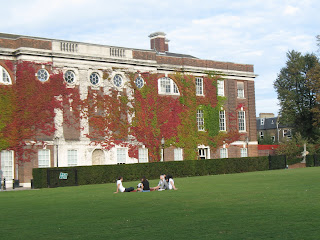
Since Sergio posted about LSE last week, I thought I'd share some initial impressions about the institution I'll be studying at: Goldsmiths.
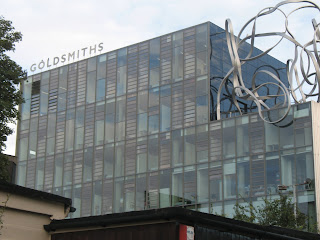
As you can tell by the crazy steel sculpture on the building above, Goldsmiths is London's "creative" university. It offers degrees in drama (which I'll be pursuing), visual arts, music, media and communications, as well as the social sciences, and humanities etc. etc.

Some of its best-known graduates are in the fields of art and fashion: including designer Vivienne Westwood, artist Damien Hirst (he of the pickled sharks and the diamond-studded skull) and Steve McQueen (not the 60s movie star, the video artist who represented Britain in the most recent Venice Biennale and whose first commercial feature was the extraordinary "Hunger," a beautiful and brutal depiction of the last days of IRA hunger striker Bobby Sands).

What have I got in common with those three? Admittedly, not much. Except that I do fancy myself an artist (and, like McQueen, a politically-engaged one).

But the question reveals some aspects of why the prospect of starting a course at Goldsmiths is both exciting and a little bit intimidating for me...
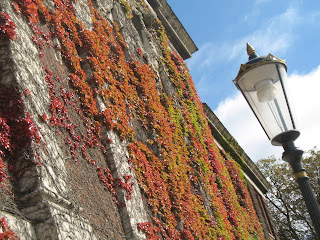
Though there might be ivy on the wall of the school's main building, this is definitely not the Ivy League. From high school onward, I have been a big achiever, going to school only in really, really elite institutions (Yale, Oxford...). The culture of competition among the "best and brightest" is an environment I am thoroughly familiar with.

Goldsmiths will be different. For one thing, it has a different history. Founded in 1891 by the Worshipful Company of Goldsmiths (as in craftsmen who worked with gold) its original mission was "the promotion of technical skill, knowledge, health and general well-being among men and women of the industrial, working and artisan classes." This was certainly not the mission with which Yale or Oxford were founded!
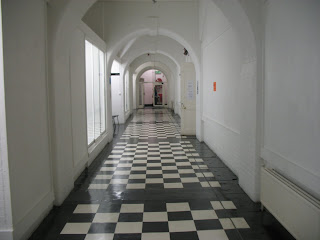
Goldsmiths history seems to suggest that it's a more "democratic" kind of a place, and a place where practice and craft may be valued as highly (if not moreso) than knowledge. I've always been good at testing and writing essays, all the academic stuff. I've also been very creative, of course, writing, directing and acting for the theater. But at Goldsmiths, the creative part will come to the foreground.
I'm very excited about my course: the MA Writing for Performance. What drew me to it is that it's something more than a "playwriting" program. Performance is defined much more broadly than just traditional plays -- it includes interdisciplinary and multimedia work, performances put on outside of traditional theatrical venues, and performances created through group collaboration, with other artists and with non-professionals.

For the past six years in New York, through my work with the All Stars as well as other groups, I've been engaged in an unofficial postgraduate course in collaborative performance-making and community organizing. It would feel strange to be returning to a traditional academic institution after getting my hands dirty and working in the trenches for so long. I've developed as a very different kind of artist, and have had very different artistic and political experiences, than when I had just graduated from Yale.

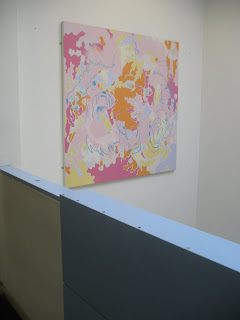
But, of course, Goldsmiths is still a school. I will be studying, not doing on-the-ground organizing. I will be writing things and refining them and getting feedback. And I'll be doing this along with a whole new group of instructors and colleagues (whom I'm supposed to be meeting tomorrow!!)

It's all very exciting, but the sense of the unkown is also very large...

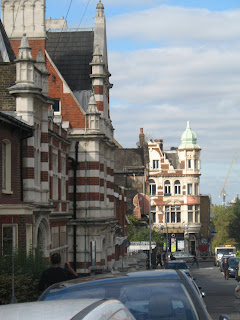
I think I'll close this entry off with a few more images. Below is a Victorian bathhouse on the Goldsmiths campus that has been converted into artists' studio space.

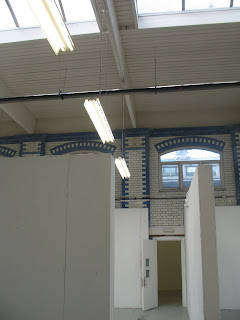
Make me want to take up painting again!

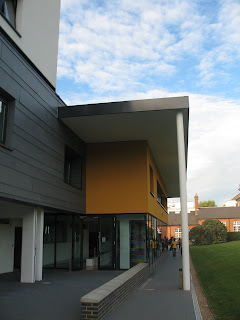
And here are some shots of the neighborhood, New Cross, in Southeast London where the school is located.

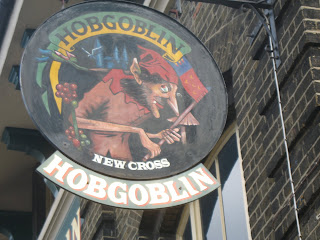
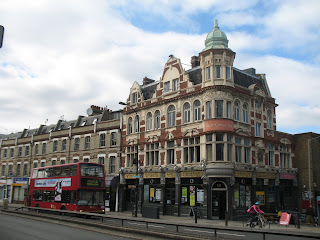
Unlike Sergio, I won't be in the pulsating center of London, but then some of the most interesting art has always come from the margins, right?

Wish me luck!!

Thursday, September 17, 2009

musings of a city rat

We took a hiatus from the South Bank today and ventured up North of the Thames to visit The London School of Economics and Political Science-- where I will be studying over the next year. Walking around the different academic buildings, I was reminded of how urban the campus is. I inevitably started thinking about my undergraduate years at Columbia. I wondered how one school, one city, one experience, would compare to the other.
On a surface level, the two schools are similar in that they are both located in the middle of extremely large, fast-paced, expensive, cosmopolitan cities. But I think that is where the similarities end-- at least in terms of what my experience at Columbia was and what I think my experience at LSE will be.

Columbia's campus was designed to be a bit of an oasis within New York. Once you walk through the gates into the main campus you can almost forget you're in the Big Apple. I remember my father, during Orientation week on campus, saying at several points that we needed to make a trip "into the city." I had to remind him and myself several times that we were in the city.

My experience at Columbia was very much shaped by how self-contained the spaces I existed in were. I lived on campus housing through all four years. Three of those years my dorms were inside the main campus, so I didn't even have to cross a street to get to class. During the week, I almost never left Morningside Heights. From the dorm, to class, to the library, to the Spec and back, all within a 7 block radius.
I would go downtown by myself during the weekends to walk around the Village, Soho, or the Lower East Side (what my friends started calling 'Sergio time'). Some of my favorite memories of my Columbia days consist of those solitary walks, discovering stores, cafes, and parks. But those moments seem very separate from the bulk of my college experience. In retrospect they seem more like brief weekend trips, as opposed to a continuation of my college life.
I can already tell my experience at LSE is going to be radically different. For one thing, I won't be living on campus. I have to take two different tube lines to get to school. I will have to deal with the morning commute and rush hour crowds. In college all I had to do was roll out of bed and walk a hundred steps to get to my class.

Also, LSE's campus is more integrated into the city. It would be inaccurate to say that the buildings are completely dispersed, but they are also not contiguous. Walking in between buildings one passes pubs, shops, even what seemed to be a plastic surgeon's office! My day to day school life will be so much more a part of the city than it ever was at Columbia.
I find this change in pace and space both intimidating and exhilarating. Intimidating perhaps because of its unfamiliarity. But exhilarating because change means being able to reconfigure your life in a whichever way you want. For instance, I harbor romantic notions of studying at cafes around the city, jetting off to different neighborhoods, depending on my mood. It's exciting to wonder what part I will play in the life of the city, and what part the city will play in my own life.